
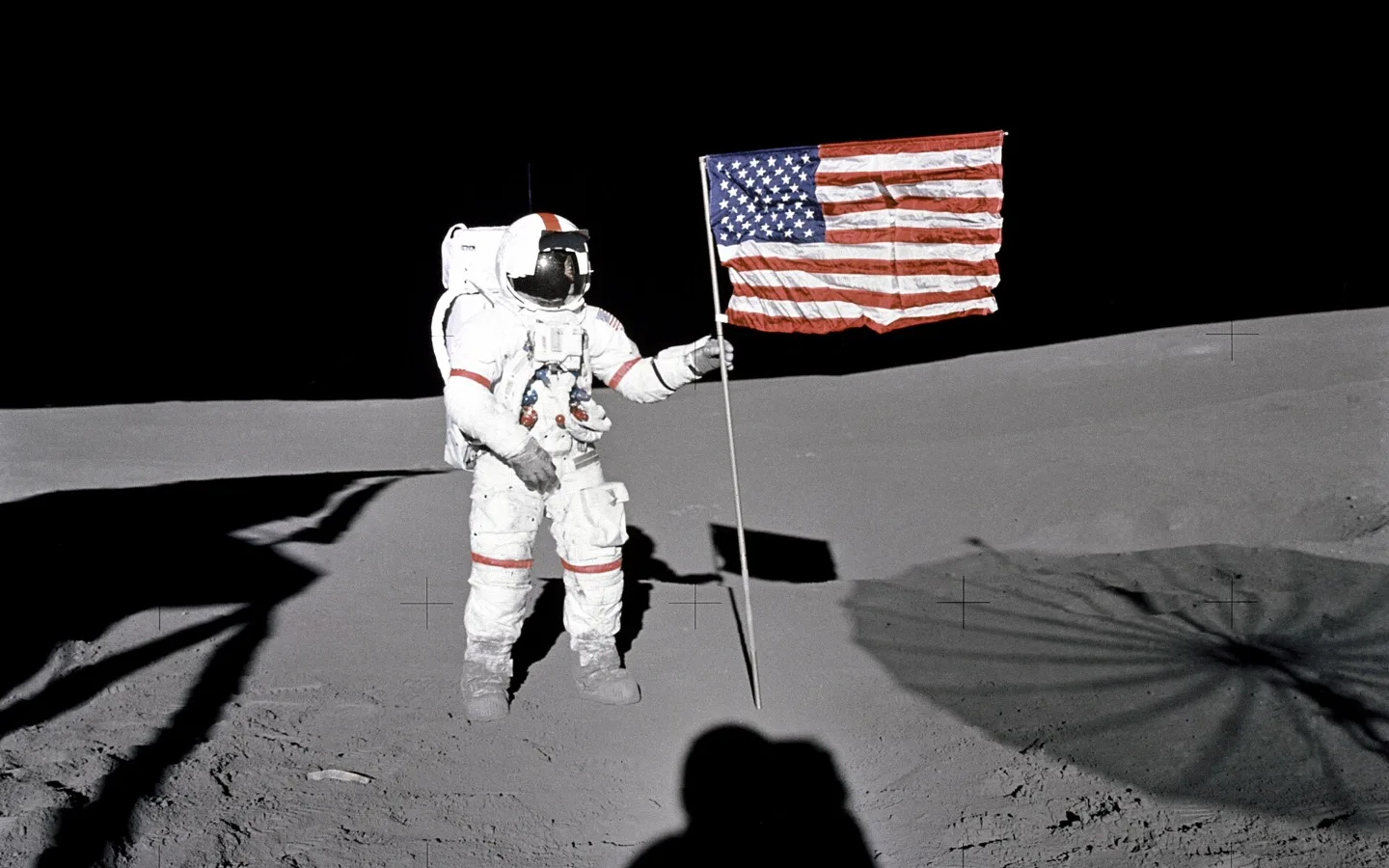
Every golfer dreams of hitting a shot nobody will ever forget. Very few manage it, and only one has managed it about 384,000 kilometres from the nearest clubhouse. In February 1971, at the end of a long day’s work on the Moon, astronaut Alan Shepard pulled a golf club out of his spacesuit and took a swing. It was a small moment in a serious mission, but it became one of the most famous golf shots ever played. Welcome to another chapter of our “Golf Origins” series.
Who Was Alan Shepard?
Long before he became golf’s first lunar player, Alan Shepard was already an American hero. On 5 May 1961, aboard the capsule Freedom 7, he became the first American to journey into space, on a suborbital flight that lasted about 15 minutes.
Almost ten years later he was back, this time as commander of Apollo 14. The mission launched on 31 January 1971 with Shepard, Edgar Mitchell and Stuart Roosa on board. While Roosa stayed in orbit, Shepard and Mitchell landed the lunar module Antares in the Fra Mauro highlands. At 47, Shepard became the fifth person to walk on the Moon. Capcom Bruce McCandless greeted the moment with a smile: “Not bad for an old man!”
A Six-Iron Hidden in a Sock
Shepard was a keen golfer, and he had an idea: what better way to show the world how low gravity works than with a golf ball? Not everyone at NASA was convinced. According to the USGA Golf Museum, Bob Gilruth, director of the Manned Spacecraft Center, needed some persuading. Shepard made him two promises: he would pay for the club and balls himself, and he would only swing once the mission’s real work had been done successfully.
The club itself was a clever piece of improvisation:
- The head came from a Wilson Staff Dyna-Power six-iron.
- The shaft was not a shaft at all, but the handle of a lunar sample-collecting tool, roughly the length of a six-iron shaft. Houston-area golf professional Jack Harden helped adapt the head so it could be attached on the Moon.
- The luggage was a tube sock. The club head and two golf balls travelled to the Moon in one of Shepard’s tube socks.
6 February 1971: The Shot Heard Round the World
Shepard kept his promise. Only at the very end of the second moonwalk, with the experiments deployed and the samples collected, did he step in front of the television camera, attach the head to the handle and drop a ball onto the grey lunar dust. He described it as “a little white pellet that’s familiar to millions of Americans.”
Golf in a pressurised spacesuit turned out to be hard. The suit was so stiff that Shepard could only swing with one hand, and his helmet made it difficult to see the ball at his feet. According to NASA’s own account, his first attempt topped the ball. The second barely moved it a few feet sideways, prompting astronaut Fred Haise, speaking from Mission Control, to remark: “That looked like a slice to me, Al.” The third attempt finally sent the ball into a nearby crater.
Then Shepard dropped a second ball, made good contact and watched it sail away. His verdict has become part of golf folklore:
“Miles and miles and miles.”
Alan Shepard, on his second shot, Fra Mauro, 6 February 1971
Not to be outdone, Edgar Mitchell picked up the staff of a solar wind experiment and threw it like a javelin. It landed in the same crater as Shepard’s first ball, making it, perhaps, the first ever Moon Olympics.
So How Far Did the Ball Really Go?
For fifty years, “miles and miles” was the only measurement anyone had. Then, for the shot’s 50th anniversary in 2021, the USGA worked with imaging specialist Andy Saunders to find out. Using high-resolution scans of the original Apollo 14 film, enhanced footage and images from NASA’s Lunar Reconnaissance Orbiter, they located both balls and the divot. The verdict:
- Ball one travelled about 24 yards into the crater.
- Ball two travelled about 40 yards, towards the scientific experiments the crew had set up.
So “miles and miles” was, let’s say, a golfer’s exaggeration. Every one of us has described a drive a little more generously at the end of 18 holes, and Shepard was no exception. Still, a one-handed 40-yard six-iron, struck in a spacesuit from a lie no greenkeeper would ever accept, is a shot to be proud of. As for the surface he played from, the whole Moon is about as close as you will ever get to one giant bunker.
Where Is the Moon Club Today?
The balls are still on the Moon. The club came home. In 1974, Shepard donated it to the USGA during the U.S. Open at Winged Foot, and the original is displayed today at the USGA Golf Museum and Library in Liberty Corner, New Jersey. A replica, together with the famous tube sock, can be seen at the World Golf Hall of Fame in Pinehurst, North Carolina. Shepard also gave a replica head to the Smithsonian National Air and Space Museum in 1975.
| Year | What happened |
|---|---|
| 1961 | 5 May: Alan Shepard becomes the first American in space aboard Freedom 7 |
| 1971 | 31 January: Apollo 14 launches with Shepard as commander |
| 1971 | 6 February: Shepard hits two golf balls on the Moon at Fra Mauro |
| 1974 | Shepard donates the club to the USGA at the U.S. Open at Winged Foot |
| 1975 | A replica club head joins the Smithsonian collection |
| 2021 | 50th anniversary analysis: the balls flew about 24 and 40 yards |
Why It Still Matters Today
Shepard’s shot reminds us of something every golfer knows: the game travels with you. Whether it is a links in Scotland, a parkland course in Portugal or a crater on the Moon, golf is about curiosity, a little mischief and the joy of a well-struck ball.
It also reminds us how much depends on what you wear. Shepard fought a stiff suit and heavy boots for every swing. Back on Earth, you deserve the opposite: footwear that moves with you. As we explored in our story on the origins of golf footwear, the right shoe has always been part of a good game. Every pair of Lambda Golf shoes is handmade in Portugal from premium leather, built like a fine dress shoe and performing like a sports shoe. And with Christmas on the horizon, a pair makes a gift that is very much down to earth. Explore our golf shoes for gentlemen, our golf shoes for ladies and our luxury golf shoes.
Conclusion
On 6 February 1971, a 47-year-old astronaut with a borrowed club head, a sample-collecting handle and two balls in a sock turned the Moon into a driving range. The balls went 24 and 40 yards, not “miles and miles”, but the story has travelled much further.
So the next time your ball finds a crater-sized bunker, think of Alan Shepard, smile, and take one more swing. Stay tuned for our next “Golf Origins” story.
Sources
- USGA – Shepard’s Moon Club: 50th Anniversary
- USGA – 55 Years of the Moon Club
- NASA History – 50 Years Ago: Apollo 14 Lands at Fra Mauro
- NASA – Apollo 14 Mission
- Smithsonian National Air and Space Museum – Head, Golf Club, Apollo 14, Replica
- Featured image: Alan Shepard beside the US flag at Fra Mauro, Apollo 14 (NASA GPN-2000-001120), Wikimedia Commons (public domain)