
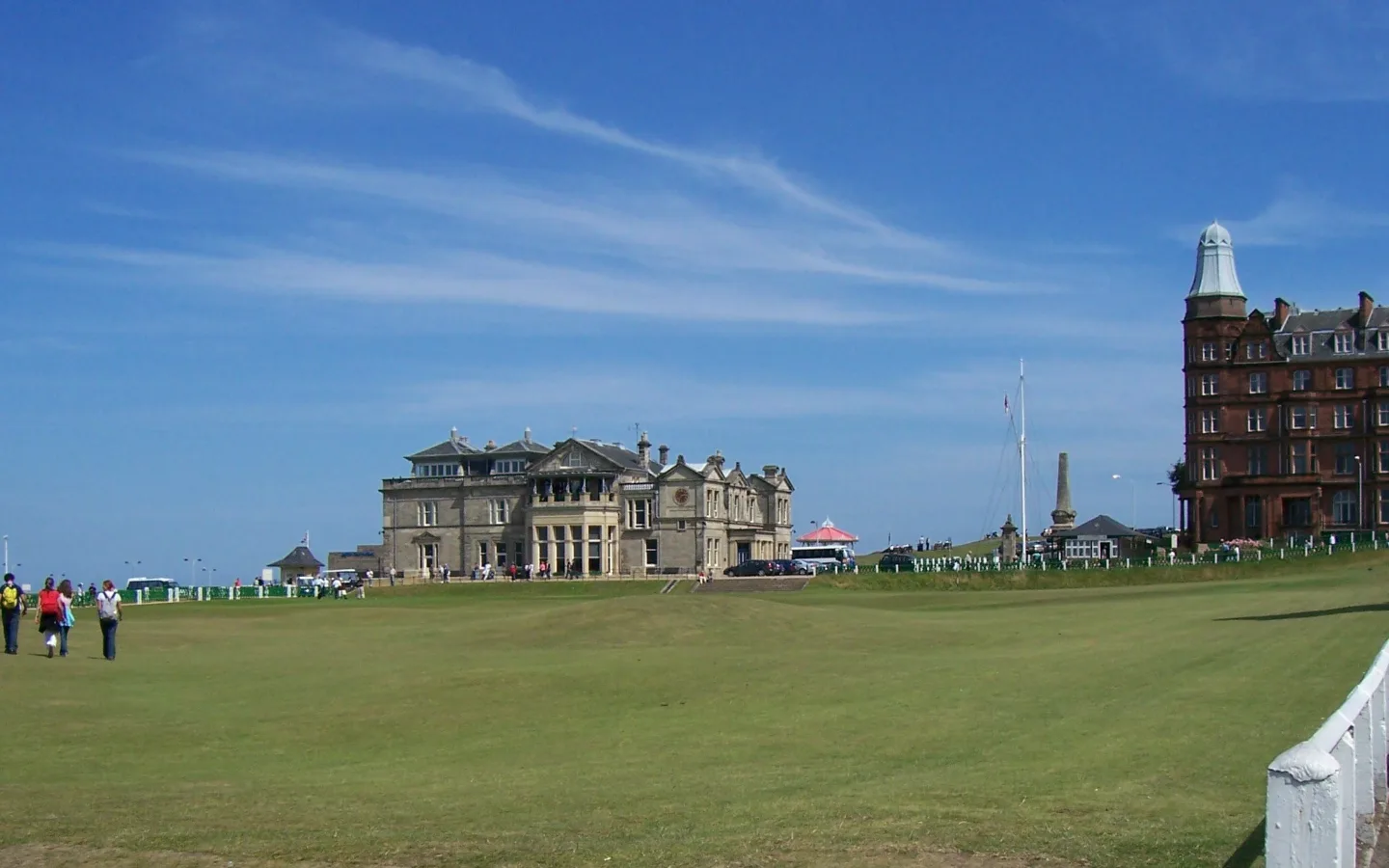
Ask any golfer why a round has 18 holes and you will probably get a shrug, a joke, or a story about a bottle of whisky. The real answer is far more interesting. It begins on a narrow strip of Scottish coastline, with a handful of gentlemen golfers who, in the autumn of 1764, decided that some of their holes were simply too short. Welcome to another chapter of our “Golf Origins” series.
Before 18: When Every Course Had Its Own Number
For most of golf’s early history, there was no such thing as a “standard” course. Golfers played whatever the land gave them. A links was laid out along the dunes, holes were cut where the ground allowed, and a round simply meant going out and coming back again.
The results were wonderfully inconsistent:
- Leith Links, home of the golfers who wrote the first known rules of golf in 1744, was played over just five holes. You can read more about them in our story on The Honourable Company of Edinburgh Golfers.
- Prestwick, birthplace of The Open, had twelve holes. When the very first Open Championship was played there on 17 October 1860, the field played three rounds of 12 holes, a total of 36.
- St Andrews, meanwhile, had 22.
A “round” was whatever your home links happened to offer.
St Andrews and Its 22 Holes
At St Andrews, the course ran out along the shoreline and then turned for home. Golfers played the holes going out and then played the same holes back, aiming at the same holes from the opposite direction. Eleven out, eleven in: 22 holes in total.
It was a clever use of a narrow piece of land, but it had a drawback. Several of the holes at the start of the course were very short, and because every hole was played twice, those short holes counted twice as well.
4 October 1764: The Day Golf Lost Four Holes
On 4 October 1764, the Society of St Andrews Golfers, led by its captain William St Clair of Roslin, made a decision that would shape the game for centuries. The first four holes were judged too short, so they were combined into two longer ones.
Because the course was played out and back, the change counted twice. Four short holes on the way out became two, and the same four on the way home became two. Twenty-two holes became eighteen: nine out, nine in.
Nobody in that room was trying to invent a global standard. They were simply improving their own course. But that course happened to be St Andrews.
How 18 Became the Rule
St Andrews’ influence grew steadily. In 1834, King William IV became the club’s patron and the Society of St Andrews Golfers became the Royal and Ancient Golf Club, the institution that would go on to lead the game. In 1858, its rules made the link official:
“One round of the Links or 18 holes is reckoned a match unless otherwise stipulated.”
Rules of the Royal and Ancient Golf Club, 1858
From then on, 18 holes was no longer just the St Andrews way. It was the way. Other clubs gradually redesigned their courses to match. Even Prestwick, home of the first twelve Opens, moved to a new 18-hole layout in 1882.
| Year | What happened |
|---|---|
| 1744 | Leith Links is played over five holes |
| 1754 | The Society of St Andrews Golfers is founded |
| 1764 | St Andrews goes from 22 holes to 18 |
| 1834 | The Society becomes the Royal and Ancient Golf Club |
| 1858 | 18 holes is written into the rules as one round |
| 1860 | The first Open is played at Prestwick, over 12 holes |
| 1882 | Prestwick moves to 18 holes |
St Andrews kept one souvenir of its out-and-back past: its famous double greens. Because golfers went out and came back to the same greens, those greens were simply shared. In 1857, Allan Robertson was paid to cut a second hole in the middle greens, and around 1870 Old Tom Morris separated the 1st green from the 17th. Today, seven large greens are still shared by two holes, one going out and one coming in. For more on the course itself, see The Old Course at St Andrews – Golf’s Sacred Ground.
What About the Whisky?
You have probably heard the legend: a bottle of Scotch holds 18 shots, so a thirsty golfer would take one nip per hole and the round ended when the bottle did. It is a great story for the 19th hole, but it is only a story. There is no historical record to support it. The real answer is less romantic and far more Scottish: a sensible committee decision about short holes.
Why It Still Matters Today
Those 18 holes shape everything about the game we play: the rhythm of the front nine and the back nine, how par adds up to a round, and the four or so hours we spend on the course.
They also shape what we ask of our feet. Eighteen holes means walking several miles over grass, sand and slopes, often in changing weather. That is exactly why we believe a golf shoe should be built like a fine dress shoe and perform like a sports shoe. Every pair of Lambda Golf shoes is handmade in Portugal from premium leather, designed to stay comfortable from the first tee to the final putt. Explore our golf shoes for gentlemen and golf shoes for ladies.
Conclusion
Golf has 18 holes not because of a grand plan, but because a group of golfers in St Andrews wanted better holes. A practical decision made in 1764 was adopted across the world, and today every round you play carries a little piece of that history.
So next time you stand on the 18th tee, raise a (metaphorical) glass to William St Clair and the gentlemen of St Andrews. Stay tuned for our next “Golf Origins” story.
Sources
- Scottish Golf History – Royal & Ancient Golf Club of St Andrews (1754)
- Scottish Golf History – Leith Links
- Prestwick Golf Club – The Open Championship
- Scottish Golf History – Coloured Flags and “Out” and “In”
- Golf Monthly – How Many Shared Greens Are There at St Andrews?
- LiveAbout – Why Golf Courses Have 18 Holes
- Featured image: The Old Course and R&A Clubhouse, Wikimedia Commons (public domain)