
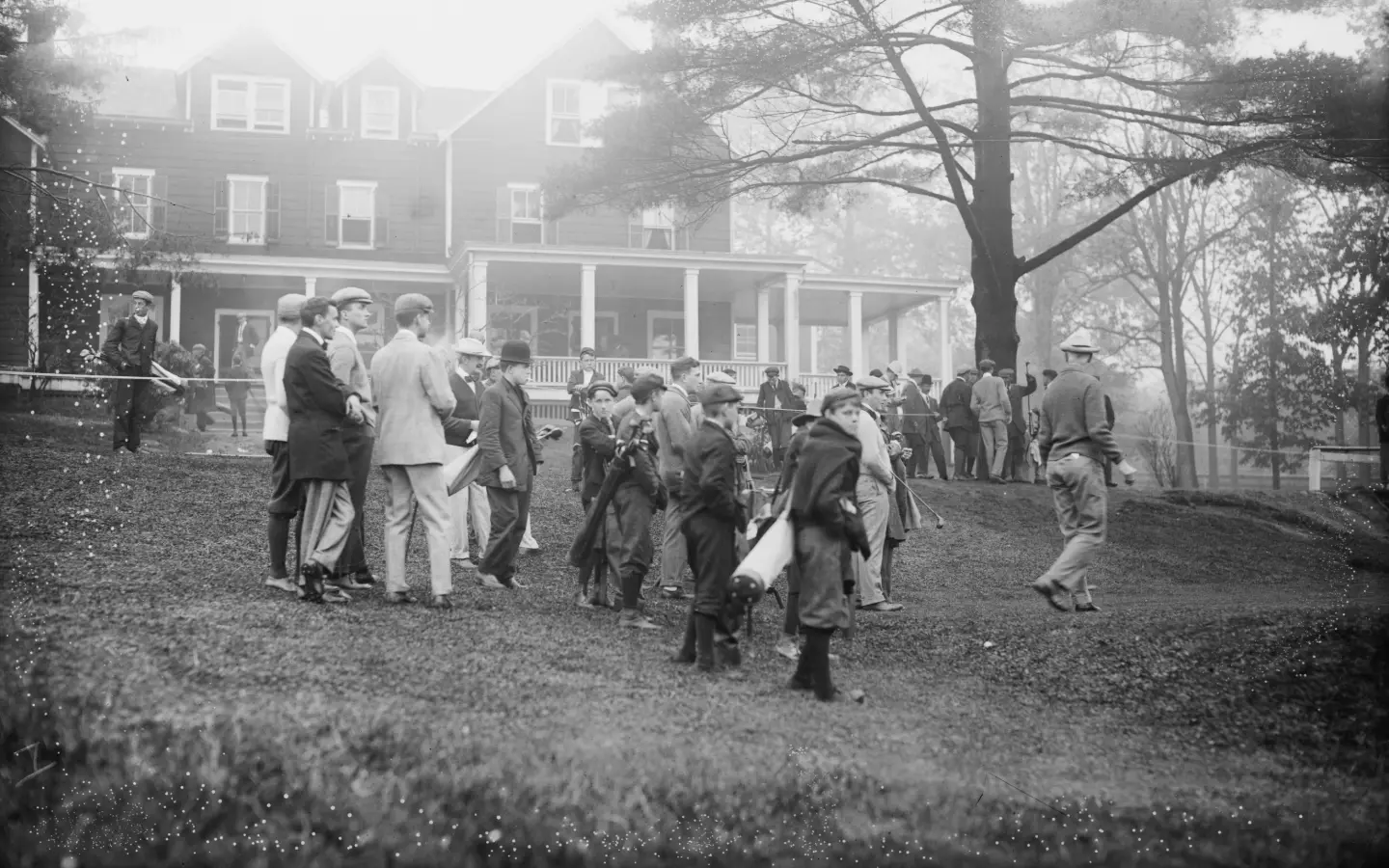
It is the shortest word in golf and probably the most important. One loud syllable across the fairway, and everyone ahead instinctively ducks. Every golfer learns it on day one, yet few know where it comes from. Was it a soldier’s warning? A caddie’s nickname? Or just an old Scottish word for “ahead”? Welcome to another chapter of our “Golf Origins” series.
What Does “Fore!” Mean?
Put simply, “fore” is a warning. Merriam-Webster defines it as a cry “used by a golfer to warn anyone within range of the probable line of flight of the ball”, and dates its first known use in print to around 1878. The cry was almost certainly heard on Scottish links long before anyone wrote it down.
Where the word came from is less certain. Historians offer several explanations, starting with the most widely accepted.
The Forecaddie Theory: A Boy Running Ahead
In the early days of golf, balls were handmade and expensive. The leather “featherie”, stuffed with boiled feathers, was easy to lose and costly to replace. So golfers who could afford it employed a forecaddie: a boy or man who walked ahead of the players and stood near where the ball was likely to land, ready to spot it and mark its position. As Golf Monthly explains, forecaddies were especially useful on blind holes, where the player on the tee could not see who was standing in the landing area.
Golf’s first named caddie was exactly that. According to Scottish Golf History and the Caddie Hall of Fame, a boy called Andrew Dickson ran ahead as forecaddie for the Duke of York, the future King James VII of Scotland and II of England, when he played on Leith Links around 1681. Dickson later made his living in the golf trade, and in old age he told his story to the historian William Tytler. It was recorded in the 1824 Rules of the Thistle Golf Club:
“Dickson was then performing the duty of what is now commonly called a fore-cady.”
Rules of the Thistle Golf Club, Edinburgh, 1824
Imagine a ball heading straight for the boy waiting down the fairway, and the golfer shouting “Forecaddie!” to warn him. Over time, the theory goes, the shout was shortened to the quicker “Fore!”. This is the explanation favoured by Scottish Golf History, and it is the one most often repeated by golf writers today.
The Artillery Theory: “Beware Before!”
The second theory takes us to the battlefield. Soldiers firing cannon or muskets over the heads of troops standing in front of them would shout a warning, often given as “Beware before!”, so that those ahead could drop to the ground. Golfers, the story goes, borrowed the cry.
This version has some respected supporters. The USGA’s golf history FAQ describes “fore” as a Scottish shortening of “before” or “afore” that most probably began in military circles before golfers adopted it in the 18th century. However, the theory is contested. Scottish Golf History notes that modern historians have largely rejected it, partly because the military commands do not match neatly and partly because no clear Scottish link has been found.
Or Simply a Word for “Ahead”?
There is also a plainer answer. “Fore” is an old English and Scots word meaning “in front” or “ahead”, the same “fore” we find in foreground, forehead and forecast. Some etymologists argue that golfers were never shortening anything at all: they were simply calling out to whoever was ahead of them. Merriam-Webster calls the word “probably short for before“, and Golf Monthly also mentions this view.
The theories may also overlap: the forecaddie got his name because he stood “fore”, in front of the players. Either way, the cry was born in Scotland, where so much of golf began, from the Old Course at St Andrews to the historic links at Leith, where the Gentlemen Golfers, later known as the Honourable Company of Edinburgh Golfers, wrote the first rules of golf in 1744.
| Year | What happened |
|---|---|
| c. 1681 | The Duke of York plays golf on Leith Links, with a boy named Andrew Dickson running ahead as his forecaddie |
| 1744 | The Gentlemen Golfers of Leith write the first known rules of golf |
| 1824 | The Rules of the Thistle Golf Club record Dickson’s story and use the word “fore-cady” |
| c. 1878 | Dictionaries record the first printed use of “fore” as a golfer’s warning cry |
| 2019 | The modernised Rules of Golf still name “fore” as the traditional warning |
| 2024 | The DP World Tour announces sanctions for players who fail to shout “fore” |
“Fore!” in the Rules of Golf Today
Three centuries later, the word is still part of the game’s official language. The old etiquette section of the Rules of Golf said that a player who hits a ball towards someone “should immediately shout a warning” and that “the traditional word of warning in such situations is ‘fore.'” When the Rules were modernised in 2019, the idea moved into Rule 1.2a, which asks players to show consideration for others by looking out for their safety, and to shout a warning, “such as the traditional warning of ‘fore'”, if a ball might hit someone. The R&A’s Spirit of the Game guidance makes the same point.
Professional golf takes it seriously too. In April 2024, the DP World Tour told its players they would face sanctions if they failed to shout “fore” when a warning was needed, a decision Golf Monthly also reported.
A few simple habits keep everyone safe:
- Shout early and loudly. If there is any doubt, shout. Nobody minds a warning that turned out to be unnecessary.
- Add a direction. “Fore left!” or “Fore right!” tells people where the danger is coming from.
- If you hear it, don’t look up. Turn away, crouch and protect your head with your arms.
From the Links to Your Feet
The forecaddie spent his day running ahead over rough ground in all weathers, long before anyone thought about comfortable golf shoes. As we explored in the origins of golf footwear, what you wear on your feet has always shaped the way the game is played.
Every pair of Lambda Golf shoes is handmade in Portugal from premium leather, built like a fine dress shoe and performing like a sports shoe, so you are ready to walk 18 holes and still look the part in the clubhouse. With Christmas approaching, they also make a thoughtful gift for the golfer who has everything, except perhaps the habit of shouting “fore” on time. Explore our golf shoes for gentlemen, our golf shoes for ladies and our luxury golf shoes.
Conclusion
Nobody can say for certain who shouted the first “fore”. The most widely accepted explanation points to the forecaddies who ran ahead of golfers on the Scottish links, with Andrew Dickson at Leith as the first we know by name. The artillery story is colourful, but historians remain sceptical.
Whatever its origin, the word has lasted for centuries because it does its job: one short shout that keeps everyone on the course safe. So the next time a shot drifts towards the trees, take a breath and shout it proudly. You are carrying on one of golf’s oldest traditions. Stay tuned for our next “Golf Origins” story.
Sources
- Scottish Golf History – Fore!
- Scottish Golf History – 1619 Leith Links
- Caddie Hall of Fame – Andrew Dickson
- National Library of Scotland – Golf in Scotland: International
- Golf Monthly – Why Do Golfers Shout Fore?
- USGA – Golf History FAQ
- Merriam-Webster – Fore (interjection)
- USGA – Rules of Golf, Section I: Etiquette
- The R&A – Rules of Golf, Rule 1
- The R&A – Spirit of the Game
- USGA – A Brief History of the Rules, 1744 to Present
- Bunkered – DP World Tour sanctions for failing to shout fore (2024)
- Featured image: Spectators and golfers at a match, Baltusrol, 1908 (Bain News Service, Library of Congress), Wikimedia Commons (public domain)