
It is the smallest thing in your golf bag, and probably the one you think about least. You push it into the ground, set your ball on top and send it flying, often along with the tee itself. Yet the humble wooden tee has a surprisingly human story, and it starts not with a golf professional, but with a Boston dentist who disliked getting his hands dirty. Welcome to another chapter of our “Golf Origins” series.
Before the Tee: Pinches of Wet Sand
For centuries, golfers had no tee to speak of. The game’s first written rules, drafted in 1744 by the Honourable Company of Edinburgh Golfers for a competition on Leith Links, opened with a simple instruction, as the USGA recalls: “You must Tee your Ball within a Club’s length of the Hole.” Rule two added that “your Tee must be upon the Ground.” (You can read more about those pioneering golfers in our story on the Honourable Company of Edinburgh Golfers.)
In practice, a “tee” was a small mound of damp sand. According to Scottish Golf History, caddies often scooped sand straight out of the hole to build it, which did the holes no favours. Later, courses placed boxes of sand beside each teeing ground, and golfers shaped their little pile by hand or with a cone-shaped mould, as the USGA Museum describes. It worked, but it was messy, slow and hard on gloves and fingers.
Dr. George F. Grant: A Life of Firsts
George Franklin Grant was born in 1846 in Oswego, New York, the son of parents who had escaped slavery. As the Harvard Gazette tells it, he was hired at 15 to run errands for a local dentist and soon became his laboratory assistant. In 1867 he moved to Boston, worked as a lab assistant at Harvard Dental School and enrolled the following year.
Grant graduated with distinction in 1870, the second African American to earn a dental degree from Harvard. He joined the school’s teaching staff in 1871 and, according to Harvard Medical School’s history pages, became the first African American faculty member at Harvard University. From 1884 he was Instructor in the Treatment of Cleft Palate and Cognate Diseases, and he designed and patented a prosthetic, the “oblate palate”, that helped patients speak and eat more normally. His patients reportedly even included Harvard’s president, Charles Eliot.
A Better Way to Tee Up
Away from the dental chair, Grant was a keen golfer who played in a meadow near his home in Arlington, Massachusetts. Like everyone else, he teed up on sand, and he did not enjoy it. So he did what a skilled dental technician would do: he designed a better tool.
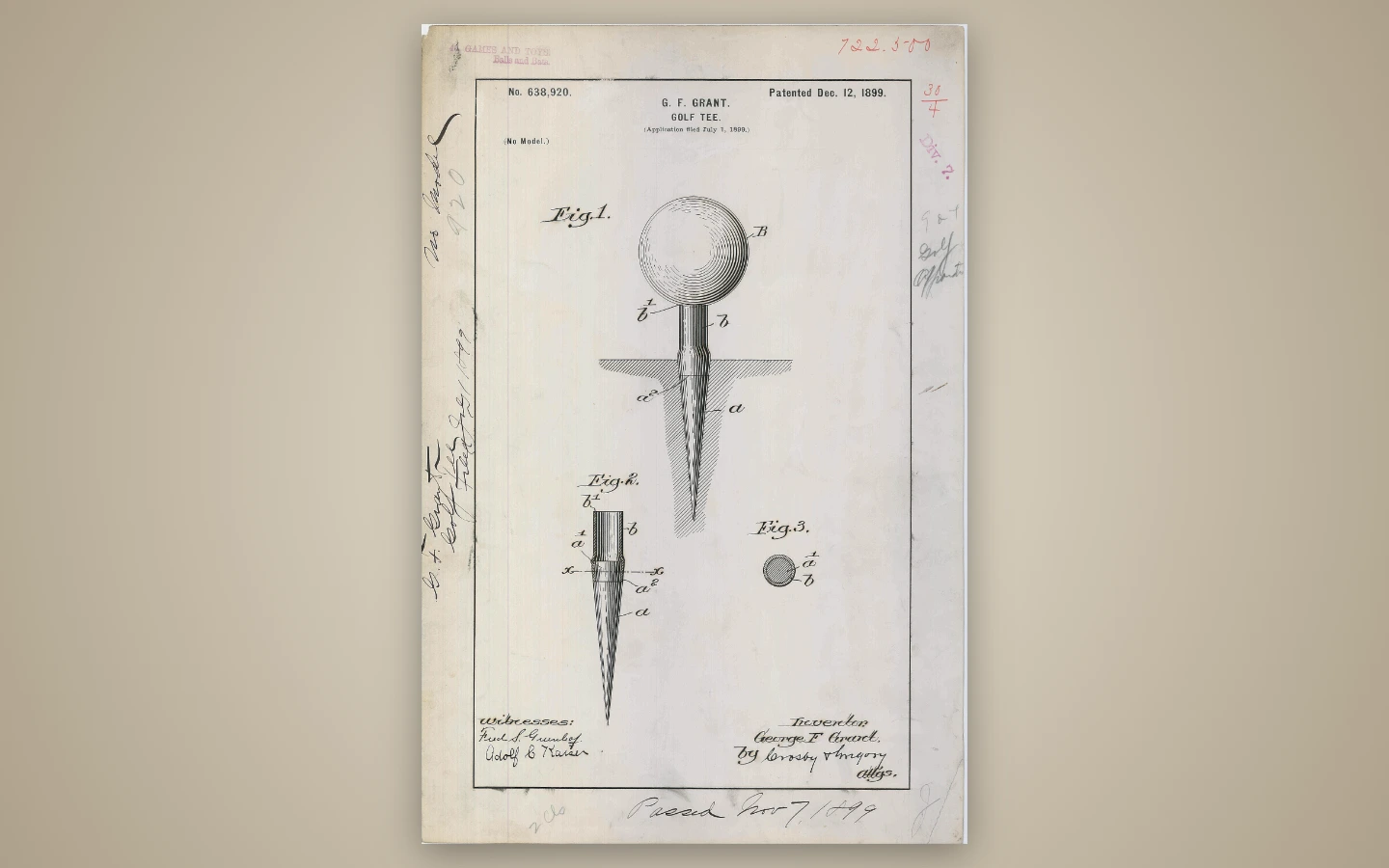
He filed his patent application on 1 July 1899, and on 12 December 1899 he was granted US Patent No. 638,920 for a “Golf-Tee”. The original patent drawing is held today by the US National Archives. His design had two parts:
- A wooden peg, tapering to a point so it could be pushed into the turf, with a small shoulder that stopped it at the right depth.
- A flexible head of rubber tubing, fitted over the top of the peg, which held the ball lightly and stood about three-quarters of an inch above the ground.
The clever part was that soft rubber head. When the club struck the ball, it simply bent out of the way, so the tee did not slow the swing. Grant’s own patent explained it perfectly:
“…yield in the direction of travel of the ball, offering no obstruction to its flight.”
George F. Grant, US Patent No. 638,920, 1899
So Did Grant Invent the Golf Tee?
You will often read that Grant “invented the golf tee”. The full story is a little more nuanced. In Scotland, William Bloxsom and Arthur Douglas of North Berwick had already devised a portable rubber tee in 1889, and several other tees with rubber tops and spikes were patented in Britain and the United States during the 1890s, as Scottish Golf History records.
What makes Grant special is that his peg, pushed into the ground with a ball resting on top, looks remarkably like the tee we use today. Both Harvard et les USGA describe his patent as the first for a wooden golf tee in the United States.
There was one catch: Grant never sold it. He had prototypes made for his own use and handed them out to family and friends. When he died in 1910, his invention was still largely unknown outside his circle.
| Year | What happened |
|---|---|
| 1744 | The first written rules ask golfers to tee up within a club’s length of the hole |
| 1846 | George Franklin Grant is born in Oswego, New York |
| 1870 | Grant graduates with distinction from Harvard Dental School |
| 1871 | He joins Harvard’s teaching staff |
| 1889 | Bloxsom and Douglas devise a portable rubber tee in North Berwick, Scotland |
| 12 Dec 1899 | Grant receives US Patent No. 638,920 for his wooden golf tee |
| 1910 | Grant dies, his tee never having been sold |
| Early 1920s | Dr. William Lowell’s Reddy Tee makes wooden tees popular |
Another Dentist Finishes the Job
Remarkably, it took a second dentist to bring the wooden tee to the masses. In the early 1920s, Dr. William Lowell of New Jersey, a member of Maplewood Country Club, began making simple wooden pegs and painting them red. He called them the “Reddy Tee”. According to the USGA and an Associated Press report, Lowell enlisted star professional Walter Hagen to use and promote them, and the idea finally caught on. Within a few years, the wooden peg had replaced the sand box, a change as lasting as golf’s move to 18 holes.
Grant’s contribution was not forgotten for good. In 2023, the Harvard School of Dental Medicine unveiled a portrait of him in its dean’s office, honouring a pioneer of dentistry, of cleft palate care and, in a small but lovely way, of golf.
Small Details, Made by Hand
Grant’s tee is a reminder that thoughtful craftsmanship often hides in the smallest details. A well-made object should simply work, and look good doing it. We feel the same way about golf footwear, a story we explored in the origins of golf footwear.
Every pair of Lambda Golf shoes is handmade in Portugal from premium leather, built like a fine dress shoe and performing like a sports shoe, so you can tee up in comfort and still look the part in the clubhouse. And with Christmas around the corner, a pair of handmade golf shoes (with a handful of wooden tees tucked inside) makes a gift any golfer will remember. Explore our golf shoes for gentlemen, our golf shoes for ladies and our chaussures de golf de luxe.
Conclusion
For centuries, golfers teed up on pinches of wet sand. In 1899, Dr. George F. Grant, a Harvard-trained dentist and the university’s first African American faculty member, patented a wooden peg with a rubber top that looks strikingly like the modern tee. He never sold it, and it took another dentist, William Lowell, to make wooden tees popular in the 1920s.
So the next time you push a tee into the ground on the first hole, spare a thought for Dr. Grant, who simply wanted a cleaner way to start his round. Stay tuned for our next “Golf Origins” story.
Sources
- Harvard Gazette – George Franklin Grant, D.M.D. 1870, honored with portrait
- Harvard Medical School, Perspectives of Change – George Franklin Grant, DMD, Class of 1870
- USGA Museum – Dr. George Grant and the evolution of the golf tee
- USGA – Celebrating 125 years of golf in America: New Jersey
- USGA – Rules Throwback: The game’s first documented rules
- US Patent No. 638,920 – Golf-Tee, George F. Grant (1899)
- US National Archives – Patent drawing for G. F. Grant’s golf tee
- Scottish Golf History – Tee
- Golf Channel (Associated Press) – Dentist commercialized the wooden golf tee
- GolfPass – George Franklin Grant, inventor of the golf tee
- Featured image: Patent drawing for G. F. Grant’s golf tee (1899), U.S. National Archives, via Wikimedia Commons (public domain)